News Center
Graphite Valley Industrial Group




Review of Covalent Chemical Control Methods for Graphene Oxide
Release time:
Jun 29,2022
Graphene has attracted extensive research interest in many fields due to its unique physical and chemical properties. However, its low solubility in most organic solvents and water, as well as its tendency to aggregate, prevent full utilization of its properties. Graphene oxide (GO) is an alternative material with high diffusivity in polar solvents. Graphene oxide contains rich oxygen-containing groups, mainly epoxides and hydroxyls, which can be further chemically derivatized. However, due to the high reactivity of graphene oxide, several reactions may occur simultaneously, usually leading to runaway graphene oxide derivatives. Recently, a research team led by Professor Cécilia Ménard-Moyon from the University of Strasbourg in France published a review article on the Nature Reviews Physics on the topic of Controlling covalent chemistry on graphene oxide, systematically discussing the chemical reactivity of graphene oxide and the problems that hinder the precise control of its functionalization, such as its instability, lack of clear chemical structure and the presence of impurities. The article focuses on the selective derivatization strategy of oxygen-containing groups and C = C bonds, as well as the challenge of unambiguously characterizing the final structure. This review not only briefly reviews the application of graphene oxide materials, links its chemistry and nanostructure with the required physical properties and functions, but also points out the future direction of improving the chemical control of graphene oxide. For more than 15 years, graphene has attracted interest in various fields due to its unique optical, electrical, thermal and mechanical properties. However, the low dispersibility of graphene in most organic solvents and water and its aggregation limit its processability. In addition, the sp2 basal plane of graphene is relatively inert, which inhibits its covalent functionalization, thus limiting its application range. In contrast, the oxidized form of graphene-graphene oxide (graphene oxide)-is highly dispersible in many solvents, and the rich oxygen-containing moiety provides a handle for extensive chemical derivatization. These properties facilitate processing and make the production of graphene oxide materials inexpensive and scalable. Graphene oxide is composed of flexible two-dimensional graphite flakes of atomic thickness with lateral dimensions on the nanometer to micrometer scale. The surface of graphene oxide is modified by oxygen-containing groups: many epoxide and hydroxyl (-OH) moieties are mainly located on the basal plane, while some carboxyl (-COOH) groups are present at the edges. It must be understood that graphene oxide is not a single compound, but a heterogeneous class of materials. The physical and chemical properties and corresponding applications of graphene oxide are defined by its composition and structure at different scales (Figure 1a). The properties depend on chemical details (e. g., the level of oxidation, the proportion and location of oxygen-containing groups, and the number of remaining non-oxygen groups), the density of defects and nanopores, and the distribution and aggregation of functional groups. The properties of the graphene oxide can be further modified by changing the microstructure, I .e., the size distribution and relative arrangement of the flakes (e. g., liquid suspended flakes, hydrogels, or laminates). This layered structure determines the optical and electrical properties of graphene oxide-based materials, as well as liquid, ion and gas transport properties. The chemical modification of graphene oxide provides an opportunity to controllably change the properties of related materials, improving their performance in many applications, including in environmental and energy-related fields, polymer composites, sensing, filtration, catalysis and Nanopharmaceuticals and other fields. However, since graphene oxide is unstable under heat and in the presence of strong bases, functionalization must be carried out under neutral and mild conditions to avoid dehydration and reduction of graphene oxide. Due to the relatively high reactivity of oxygen-containing groups in graphene oxide, multiple reactions may occur simultaneously during the functionalization process, which may lead to side reactions and synthesis of materials with unclear composition. Thus, controlled functionalization of graphene oxide requires a synthetic strategy and accurate characterization of functionalized materials requires technology. In this review, the article outlines the chemical reactivity of graphene oxide and discusses the factors that hinder the precise control of graphene oxide functionalization; these include the lack of a clear chemical structure of graphene oxide macromolecules, its thermal instability, Incompatibility with strong bases and possible impurities. The article details the selective covalent derivatization of different oxygen-containing groups and C = C bonds, focusing on facilitating the understanding of reactivity rather than mechanical details. The discussion in this article is limited to covalent chemistry because it provides graphene oxide conjugates that are more stable than graphene oxide conjugates produced by non-covalent interactions. Failure to grasp the heterogeneity of Go material often leads to erroneous conclusions and erroneous communication in the literature. Finally, the structure-function relationship of functionalized graphene oxide is discussed in the application examples of environment and energy related fields. Graphene oxide has been developed for various applications in different fields, from sensing, catalysis and composite materials to environmental science, energy and biomedicine. The chemical composition of graphene oxide affects its properties, and the covalent grafting of molecules on its surface represents a valuable strategy to adjust and improve the properties of materials to suit different applications. The article introduces examples of the use of functionalized graphene oxide in most application fields (ie, environmental and energy-related fields), and focuses on the study of functionalization of graphene oxide under mild conditions and high chemical selectivity. Environmental Applications In order to improve sustainability and energy efficiency, investigations have been conducted on the environmental application of graphene oxide in drinking water purification; membrane separation processes, including seawater desalination; and the collection of osmotic energy. The function and performance of graphene oxide-based materials in environmental applications, especially in the development of separation membranes, depends not only on the chemical properties of graphene oxide, but also on its hierarchical structure. A separation membrane made of graphene oxide consists of horizontally aligned graphene oxide flakes and nanosheets, stacked into a layered structure that is stable in water. Once hydrated, the film swells and the nature of the functional groups determines the interlayer distance between the lamellae. As the solution permeates between the sheets, it flows in a percolation path between the separated functional groups along the graphene oxide basal plane until it snakes through the membrane. The frictionless surface of the pristine graphene region facilitates ultrafast transport of water. The selectivity of the membrane is based on the size and dewaterability of the hydrated ion (determined by the interlayer distance), charge selectivity (through protonatable functional groups) and chemical affinity. For the accepted pressure-driven desalination (reverse osmosis) technology, graphene oxide membranes have not yet reached the performance of traditional thin-film composite membranes, mainly because of the poor ion/water selectivity of graphene oxide. Attempts to reduce the interlayer distance between graphene oxide flakes by physical confinement and chemical cross-linking have not significantly improved reverse osmosis performance. However, due to its high charge selectivity, graphene oxide membranes may still dominate in two emerging technologies: desalination by electrodialysis and energy harvesting by reverse electrodialysis. Other prominent applications of graphene oxide membranes are organic solvent separation and pervaporation, which is a membrane evaporation process that separates organic-water and organic-organic mixtures. Energy Applications Due to the increasing demand for energy, fuel cells have attracted great interest because they are an environmentally friendly and efficient alternative energy source suitable for many applications. There are numerous articles on the use of functionalized graphene oxide in energy-related applications. In the article, the authors highlight several examples where the functionalization of graphene oxide has been well controlled. Proton exchange membrane (PEM) fuel cells are usually made of polyelectrolytes, which convert chemical energy into electrical energy through an electrochemical reaction between hydrogen and oxygen, while producing water and heat. The performance of proton exchange membranes depends to a large extent on their proton transport capacity. Therefore, a lot of research work has been invested in the development of proton exchange membranes with high proton conductivity. In this regard, there are mainly two methods: modifying existing polyelectrolytes and proton exchange membranes with additives, or synthesizing new polyelectrolytes to design new proton exchange membranes. For example, graphene oxide functionalized with Nafion by an atom transfer radical addition reaction is used as an additive for Nafion-based composite proton exchange membranes for fuel cells. Compared with Nafion membrane, the composite shows higher proton conductivity. The improvement in performance is attributed to the aggregation of the sulfonic acid groups of the Nafion chains grafted onto graphene oxide, forming proton-conducting domains. As analyzed in this paper, the relatively low production cost of graphene oxide, its dispersibility in various solvents including water, and its tunable surface chemistry make graphene oxide an attractive building block for multifunctional materials. In many applications, maintaining the intrinsic properties of graphene oxide is critical. For example, the high density of oxygen-containing groups in graphene oxide leads to high water dispersibility and high proton conductivity and water retention. Therefore, the derivatization of graphene oxide must be well controlled to impart new properties, and the functionalized samples must be thoroughly characterized. These tasks are complicated because the chemical structure of graphene oxide has not been fully elucidated, and the level of defects and the ratio of different oxygen-containing groups may vary depending on the synthesis scheme and the source of the graphite. All structural models focus on the fact that the basal plane of graphene oxide is rich in epoxides and hydroxyl groups, which can be functionalized to adjust the properties of the material, while the carboxyl groups are only present in small amounts. Although great progress has been made in the functionalization of graphene oxide, the chemical properties of graphene oxide are not always well controlled and are not fully understood. The article points out that the reactivity of graphene oxide is determined by a complex set of factors, because the oxygen-containing groups are located in an abundant and unusual chemical environment, and significant in-plane distortion and strain in the crystal lattice will increase their reactivity. Due to the different oxygen-containing groups on the surface of graphene oxide and the high chemical reactivity of certain reagents, simultaneous reactions may occur to produce uncontrolled graphene oxide derivatives. The main purpose of this review is to clarify the chemical reactivity of graphene oxide and provide key and useful suggestions on how to promote its functionalization without reducing materials that will affect its performance. The article emphasizes the importance of chemoselective reactions, which allow one specific oxygen-containing group or C = C bond to be derivatized without affecting other moieties, thus providing the possibility for controlled multi-functionalization of graphene oxide. The simplest and most effective strategies involve epoxides and hydroxyls because of their abundance. In this review, the article mainly describes reactions that do not require thermal activation and proceed at room temperature. When functionalizing graphene oxide, it is important to use mild reaction conditions, particularly in terms of temperature and pH when needed, to avoid removal of labile oxygen-containing groups and degradation of the graphene oxide framework.
Graphene has attracted extensive research interest in many fields due to its unique physical and chemical properties. However, its low solubility in most organic solvents and water, as well as its tendency to aggregate, prevent full utilization of its properties. Graphene oxide (GO) is an alternative material with high diffusivity in polar solvents. Graphene oxide contains rich oxygen-containing groups, mainly epoxides and hydroxyls, which can be further chemically derivatized. However, due to the high reactivity of graphene oxide, several reactions may occur simultaneously, usually leading to runaway graphene oxide derivatives.
 Recently, a research team led by Professor Cécilia Ménard-Moyon from the University of Strasbourg in France was based on the Nature Reviews Physics.Controlling covalent chemistry on graphene oxideThe chemical reactivity of graphene oxide is systematically discussed, and the problems that hinder the precise control of its functionalization are discussed, such as its instability, lack of a clear chemical structure and the presence of impurities. The article focuses on the selective derivatization strategy of oxygen-containing groups and C = C bonds, as well as the challenge of unambiguously characterizing the final structure. This review not only briefly reviews the application of graphene oxide materials, links its chemistry and nanostructure with the required physical properties and functions, but also points out the future direction of improving the chemical control of graphene oxide.
For more than 15 years, graphene has attracted interest in various fields due to its unique optical, electrical, thermal and mechanical properties. However, the low dispersibility of graphene in most organic solvents and water and its aggregation limit its processability. In addition, the sp of graphene2The base surface is relatively inert, which inhibits its covalent functionalization, thus limiting its application range. In contrast, the oxidized form of graphene-graphene oxide (graphene oxide)-is highly dispersible in many solvents, and the rich oxygen-containing moiety provides a handle for extensive chemical derivatization. These properties facilitate processing and make the production of graphene oxide materials inexpensive and scalable. Graphene oxide is composed of flexible two-dimensional graphite flakes of atomic thickness with lateral dimensions on the nanometer to micrometer scale. The surface of graphene oxide is modified by oxygen-containing groups: many epoxide and hydroxyl (-OH) moieties are mainly located on the basal plane, while some carboxyl (-COOH) groups are present at the edges.
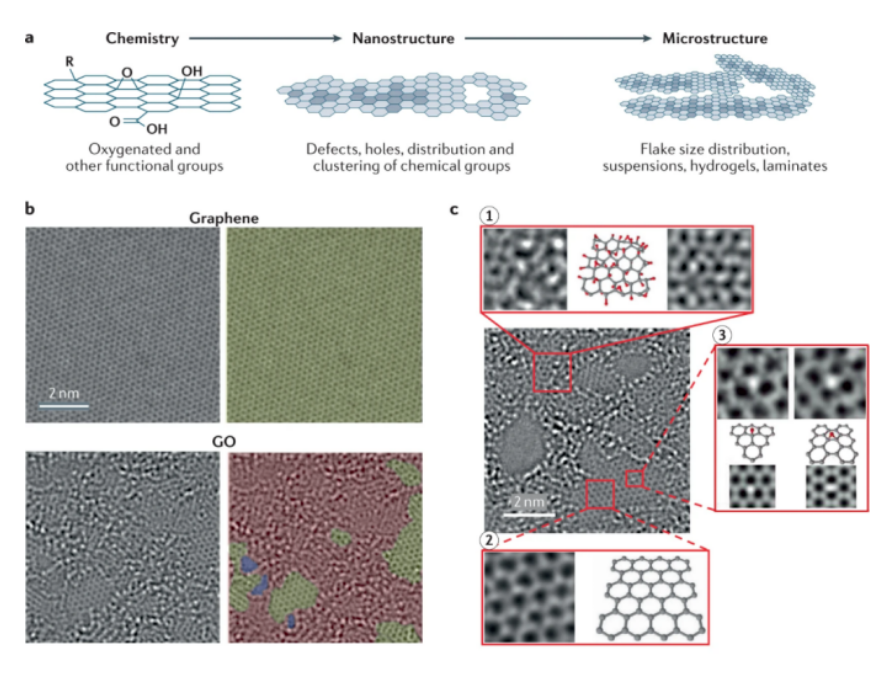
It must be understood that graphene oxide is not a single compound, but a heterogeneous class of materials. The physical and chemical properties and corresponding applications of graphene oxide are defined by its composition and structure at different scales (Figure 1a). The properties depend on chemical details (e. g., the level of oxidation, the proportion and location of oxygen-containing groups, and the number of remaining non-oxygen groups), the density of defects and nanopores, and the distribution and aggregation of functional groups. The properties of the graphene oxide can be further modified by changing the microstructure, I .e., the size distribution and relative arrangement of the flakes (e. g., liquid suspended flakes, hydrogels, or laminates). This layered structure determines the optical and electrical properties of graphene oxide-based materials, as well as liquid, ion and gas transport properties.
The chemical modification of graphene oxide provides an opportunity to controllably change the properties of related materials, improving their performance in many applications, including in environmental and energy-related fields, polymer composites, sensing, filtration, catalysis and Nanopharmaceuticals and other fields. However, since graphene oxide is unstable under heat and in the presence of strong bases, functionalization must be carried out under neutral and mild conditions to avoid dehydration and reduction of graphene oxide. Due to the relatively high reactivity of oxygen-containing groups in graphene oxide, multiple reactions may occur simultaneously during the functionalization process, which may lead to side reactions and synthesis of materials with unclear composition. Thus, controlled functionalization of graphene oxide requires a synthetic strategy and accurate characterization of functionalized materials requires technology.
In this review, the article outlines the chemical reactivity of graphene oxide and discusses the factors that hinder the precise control of graphene oxide functionalization; these include the lack of a clear chemical structure of graphene oxide macromolecules, its thermal instability, Incompatibility with strong bases and possible impurities. The article details the selective covalent derivatization of different oxygen-containing groups and C = C bonds, focusing on facilitating the understanding of reactivity rather than mechanical details. The discussion in this article is limited to covalent chemistry because it provides graphene oxide conjugates that are more stable than graphene oxide conjugates produced by non-covalent interactions. Failure to grasp the heterogeneity of Go material often leads to erroneous conclusions and erroneous communication in the literature. Finally, the structure-function relationship of functionalized graphene oxide is discussed in the application examples of environment and energy related fields.
Graphene oxide has been developed for various applications in different fields, from sensing, catalysis and composite materials to environmental science, energy and biomedicine. The chemical composition of graphene oxide affects its properties, and the covalent grafting of molecules on its surface represents a valuable strategy to adjust and improve the properties of materials to suit different applications. The article introduces examples of the use of functionalized graphene oxide in most application fields (ie, environmental and energy-related fields), and focuses on the study of functionalization of graphene oxide under mild conditions and high chemical selectivity.
Environmental Applications
In order to improve sustainability and energy efficiency, investigations have been conducted on the environmental application of graphene oxide in drinking water purification; membrane separation processes, including seawater desalination; and the collection of osmotic energy. The function and performance of graphene oxide-based materials in environmental applications, especially in the development of separation membranes, depends not only on the chemical properties of graphene oxide, but also on its hierarchical structure. A separation membrane made of graphene oxide consists of horizontally aligned graphene oxide flakes and nanosheets, stacked into a layered structure that is stable in water. Once hydrated, the film swells and the nature of the functional groups determines the interlayer distance between the lamellae. As the solution permeates between the sheets, it flows in a percolation path between the separated functional groups along the graphene oxide basal plane until it snakes through the membrane. The frictionless surface of the pristine graphene region facilitates ultrafast transport of water. The selectivity of the membrane is based on the size and dewaterability of the hydrated ion (determined by the interlayer distance), charge selectivity (through protonatable functional groups) and chemical affinity. For the accepted pressure-driven desalination (reverse osmosis) technology, graphene oxide membranes have not yet reached the performance of traditional thin-film composite membranes, mainly because of the poor ion/water selectivity of graphene oxide. Attempts to reduce the interlayer distance between graphene oxide flakes by physical confinement and chemical cross-linking have not significantly improved reverse osmosis performance. However, due to its high charge selectivity, graphene oxide membranes may still dominate in two emerging technologies: desalination by electrodialysis and energy harvesting by reverse electrodialysis. Other prominent applications of graphene oxide membranes are organic solvent separation and pervaporation, which is a membrane evaporation process that separates organic-water and organic-organic mixtures.

Energy Applications
Due to the increasing demand for energy, fuel cells have attracted great interest because they are an environmentally friendly and efficient alternative energy source suitable for many applications. There are numerous articles on the use of functionalized graphene oxide in energy-related applications. In the article, the authors highlight several examples where the functionalization of graphene oxide has been well controlled. Proton exchange membrane (PEM) fuel cells are usually made of polyelectrolytes, which convert chemical energy into electrical energy through an electrochemical reaction between hydrogen and oxygen, while producing water and heat. The performance of proton exchange membranes depends to a large extent on their proton transport capacity. Therefore, a lot of research work has been invested in the development of proton exchange membranes with high proton conductivity. In this regard, there are mainly two methods: modifying existing polyelectrolytes and proton exchange membranes with additives, or synthesizing new polyelectrolytes to design new proton exchange membranes. For example, graphene oxide functionalized with Nafion by an atom transfer radical addition reaction is used as an additive for Nafion-based composite proton exchange membranes for fuel cells. Compared with Nafion membrane, the composite shows higher proton conductivity. The improvement in performance is attributed to the aggregation of the sulfonic acid groups of the Nafion chains grafted onto graphene oxide, forming proton-conducting domains.
As analyzed in this paper, the relatively low production cost of graphene oxide, its dispersibility in various solvents including water, and its tunable surface chemistry make graphene oxide an attractive building block for multifunctional materials. In many applications, maintaining the intrinsic properties of graphene oxide is critical. For example, the high density of oxygen-containing groups in graphene oxide leads to high water dispersibility and high proton conductivity and water retention. Therefore, the derivatization of graphene oxide must be well controlled to impart new properties, and the functionalized samples must be thoroughly characterized. These tasks are complicated because the chemical structure of graphene oxide has not been fully elucidated, and the level of defects and the ratio of different oxygen-containing groups may vary depending on the synthesis scheme and the source of the graphite. All structural models focus on the fact that the basal plane of graphene oxide is rich in epoxides and hydroxyl groups, which can be functionalized to adjust the properties of the material, while the carboxyl groups are only present in small amounts. Although great progress has been made in the functionalization of graphene oxide, the chemical properties of graphene oxide are not always well controlled and are not fully understood.
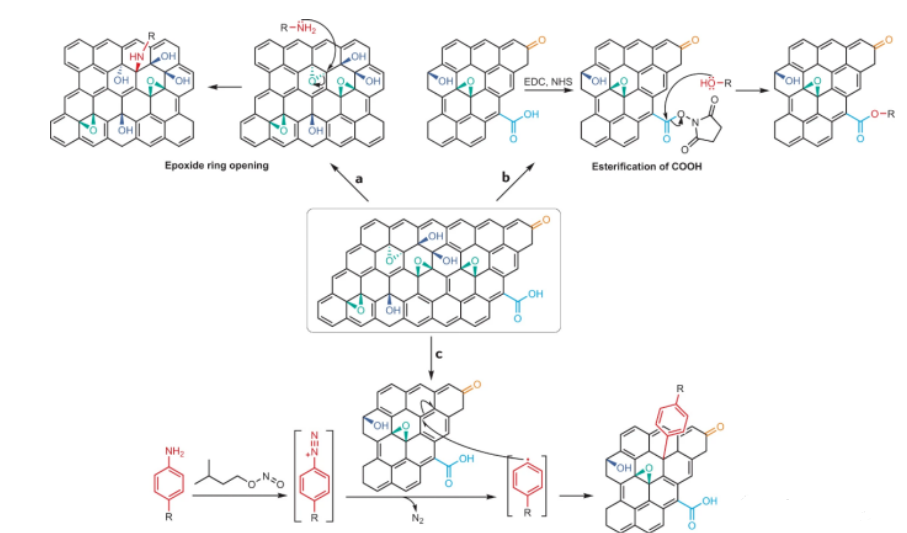
The article points out that the reactivity of graphene oxide is determined by a complex set of factors, because the oxygen-containing groups are located in an abundant and unusual chemical environment, and significant in-plane distortion and strain in the crystal lattice will increase their reactivity. Due to the different oxygen-containing groups on the surface of graphene oxide and the high chemical reactivity of certain reagents, simultaneous reactions may occur to produce uncontrolled graphene oxide derivatives.
The main purpose of this review is to clarify the chemical reactivity of graphene oxide and provide key and useful suggestions on how to promote its functionalization without reducing materials that will affect its performance. The article emphasizes the importance of chemoselective reactions, which allow one specific oxygen-containing group or C = C bond to be derivatized without affecting other moieties, thus providing the possibility for controlled multi-functionalization of graphene oxide. The simplest and most effective strategies involve epoxides and hydroxyls because of their abundance.
In this review, the article mainly describes reactions that do not require thermal activation and proceed at room temperature. When functionalizing graphene oxide, it is important to use mild reaction conditions, particularly in terms of temperature and pH when needed, to avoid removal of labile oxygen-containing groups and degradation of the graphene oxide framework.
Related News
Contact Information
National Service Hotline:86-451-88118909
Address: 1299 Jubao 3rd Road, Songbei District, Harbin City
Telephone:86-451-88118909
WeChat Public Number

Copyright©2024 Graphite Valley Industrial Group | Business License